
Increasing an advertising budget can feel like the obvious next move when a business wants more leads. It is also one of the easiest ways to scale the wrong thing.
A campaign does not become strategically sound because more money moves through it. If conversion measurement is incomplete, search intent is poorly controlled, the landing page is disconnected from the ad, or the business cannot distinguish a qualified lead from a low-value inquiry, additional spend may simply produce more uncertainty.
For service businesses, the better question is not “How much should we spend?” It is: “What must be true before additional budget deserves to be deployed?”
There is no universal Google Ads budget that is correct for every business. Budget should reflect advertising goals, available demand, economics, and what the organization can responsibly invest. Budget is a control mechanism—not a strategy.
Start With Measurement, Not Spend
Before a campaign is scaled, the business should be able to answer a basic question: What is the campaign optimizing toward?
A form submission is not necessarily the same thing as a qualified opportunity. A phone call is not necessarily a sale. A booked appointment may carry more business value than a generic contact form.
Google Ads conversion measurement is designed to help advertisers understand which keywords, ads, ad groups, and campaigns contribute to valuable customer activity. That measurement can also inform automated bidding.
If the account measures only clicks while the business actually values qualified appointments, the gap between media metrics and commercial reality remains too wide. The first layer of maturity is accurate conversion tracking. The next is better conversion definition.
For businesses where the sale occurs after a call, estimate, consultation, or CRM process, later-stage outcomes can also become part of the measurement architecture. The objective is not simply to tell an advertising platform that something happened. It is to distinguish which outcomes matter.
Examine the Searches You Are Paying For
Search campaigns are connected to what people search. But keywords and actual search terms are not identical. That distinction matters.
Before increasing spend, examine which searches are consuming the existing budget. Are people searching for the service being sold? Are searches informational when the campaign requires immediate acquisition? Are job searches, DIY terms, unrelated products, or services outside the company’s scope generating unnecessary clicks?
Negative keywords and search-term analysis remain important tools for controlling relevance. A larger budget does not repair weak search alignment. It gives weak alignment more room to operate.
Review Geography With Business Reality in Mind

Location targeting deserves the same scrutiny. A company should distinguish the geographic territory it can operationally serve from the geographic territory an advertising campaign is currently reaching.
For a local service business, lead volume means little when inquiries consistently originate outside the practical service area. Media geography should reflect operational geography.
The Landing Page Must Continue the Search
An advertisement creates an expectation. The landing page should fulfill it.
If someone searches for emergency sprinkler repair, the campaign should not casually send that visitor to a broad homepage where irrigation repair is one item among fifteen. If someone responds to a tightly defined offer, the landing environment should make that offer immediately understandable.
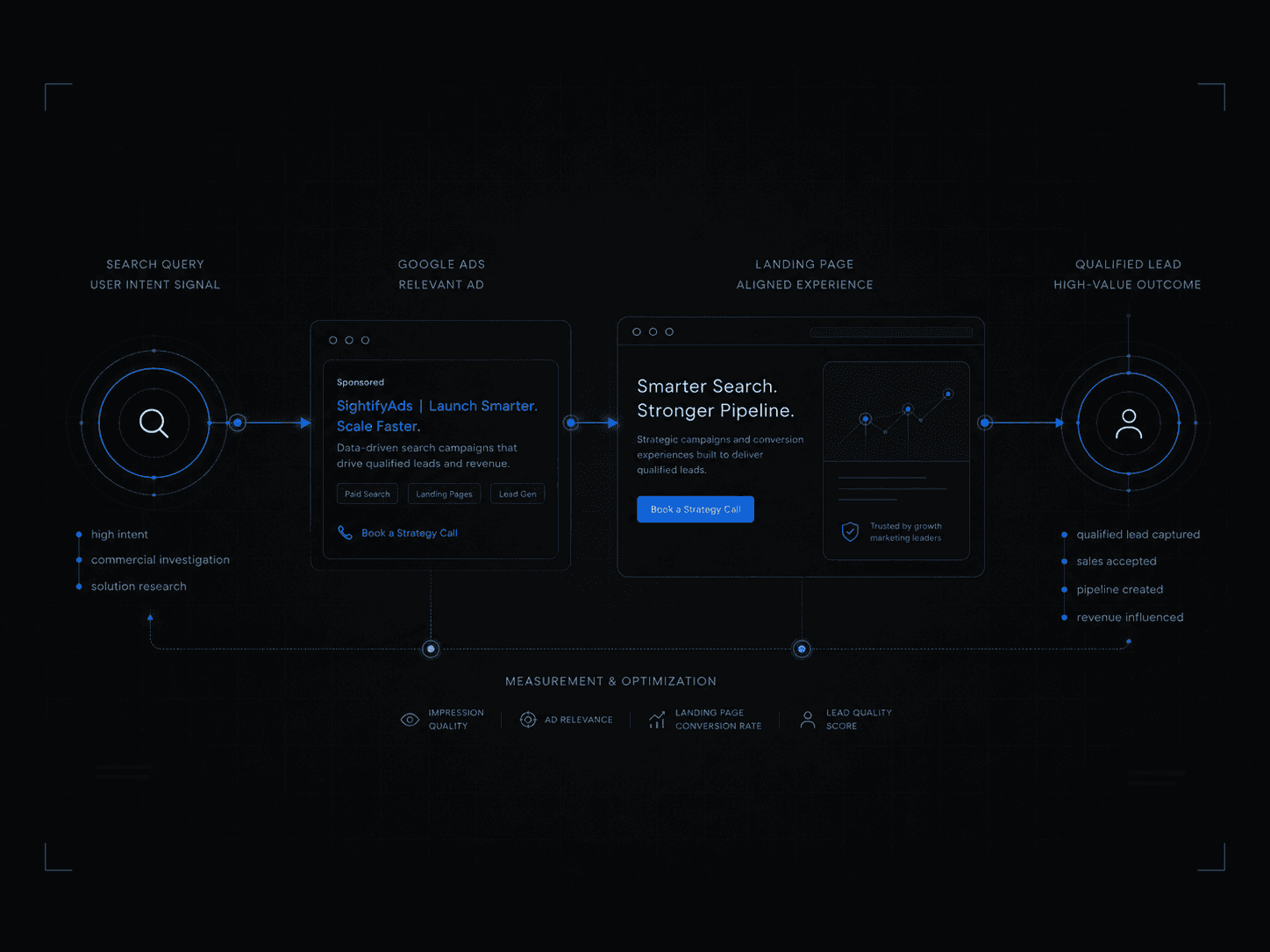
The strongest paid-search path usually feels continuous: search → ad → landing page → action. Each transition should reduce ambiguity rather than introduce it.
Look Beyond Cost per Lead
Cost per lead is useful. It is not sufficient.
Suppose Campaign A produces ten leads at a lower cost while Campaign B creates fewer inquiries at a higher cost. Campaign A appears stronger until the business discovers that Campaign B produces materially more qualified opportunities. The economics change immediately.
For service businesses, campaign analysis should increasingly connect media data with downstream outcomes: qualified lead rate, booked appointments, estimates issued, sales accepted, revenue, and, where reliably measurable, customer value.
The stronger question is not simply “How inexpensive was the lead?” It is “What was the lead worth?”
Scale Only After You Know What You Are Scaling
Additional budget makes sense when the underlying system has earned it. That does not require perfection. Paid media is iterative.
But there should be enough clarity to understand what demand is being targeted, what action is being measured, what a qualified outcome looks like, where the traffic is going, whether the page supports the promise, and whether the business can handle the demand being created.
A larger budget should expand a disciplined system. It should not substitute for one.
SightifyAds Perspective
We view budget as the final lever in a larger acquisition system—not the first. Measurement, search intent, campaign structure, landing-page alignment, geography, and lead quality should establish the foundation. Scale then becomes a business decision supported by evidence rather than optimism.



Turn Insight Into Execution.
SightifyAds connects strategy, media, web experiences, local visibility, and measurement around clear business objectives.
Insights