Full-Funnel Marketing for Service Businesses: Connecting Ads, Website, Local Search, and Follow-Up
More marketing activity does not automatically create more growth. The stronger question is whether every customer touchpoint leads coherently to the next.
Insights
SightifyAds
·
6 min read
Growth Strategy
Growth problems are often diagnosed as traffic problems. Sometimes they are not.
A company may already receive clicks, calls, profile views, form submissions, social engagement, and website traffic. Yet the system still underperforms.
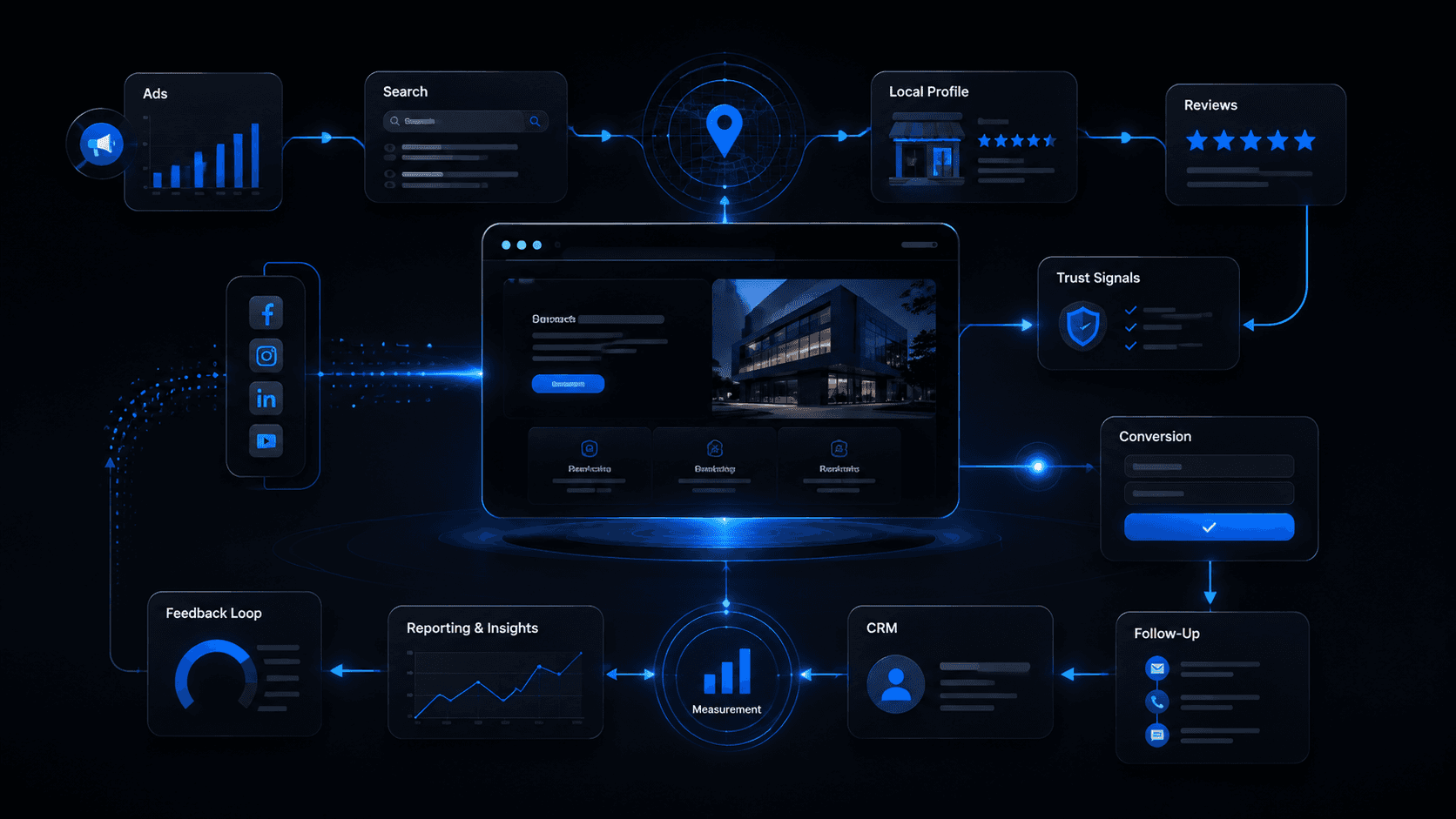
Why? Because activity can exist without continuity. The advertisement says one thing. The website says another. The Google Business Profile is incomplete. The landing page does not match the campaign. The form does not qualify the lead. The CRM does not preserve context. Follow-up is inconsistent. Marketing reports “conversions,” while the owner sees few actual customers.
Each component may be functioning individually. The journey is not.
Start With the Customer, Not the Channel
Businesses often structure marketing around platforms: Google Ads, Meta Ads, SEO, Website, Email, CRM.
Customers do not experience a business that way. They experience moments: a search, an advertisement, a recommendation, a map result, a website, a review, a form, a phone call, a follow-up.
The strategic job is to make those moments feel connected.
Stage One: Visibility
The first question is: Where can the right customer discover the business?
High-intent search can create one form of visibility. Local Search and Maps can create another. Paid social can introduce or reinforce demand. The business does not automatically need every channel. It needs the channels that fit how customers discover and evaluate the offer.
Stage Two: Relevance
Attention has limited value if the next experience feels disconnected. The landing environment should answer the intent that produced the visit.
Paid-search visitors should find the service they searched for. A local-profile visitor should recognize the same company, branding, services, and information on the website. A paid-social prospect should land in an environment that continues the promise made by the creative. Every transition should preserve context.
Stage Three: Trust
Before action comes confidence. Visitors evaluate signals such as clarity, design quality, reviews, work examples, business information, pricing context, certifications, process, ownership, and responsiveness.
Trust does not require pretending to be larger than the company is. Fabricated employees, invented case studies, fake metrics, or unsupported superlatives can destroy credibility. Premium brands communicate authority through precision. They show what is true.
Stage Four: Conversion


Every high-intent path needs an obvious next action: Call, Book, Request an Estimate, Start a Project, Apply, Purchase.
The desired action should reflect the buying process. A low-cost transactional purchase and a high-value consulting engagement do not necessarily need the same conversion architecture. The CTA is not simply a button. It is the transition from marketing to commercial engagement.
Stage Five: Measurement
When an action occurs, the system should record it. But measurement should not stop there when the business model requires deeper qualification.
Was the inquiry legitimate? Did the prospect qualify? Was an appointment booked? Was an estimate issued? Did revenue result? These answers turn activity into business intelligence.
Stage Six: Follow-Up
This is where many marketing systems become disconnected. Generating a lead is not the same thing as converting one.
Once an inquiry arrives, someone or something must respond. That may involve a salesperson, receptionist, CRM workflow, scheduling system, email, SMS, AI-supported receptionist, or a combination of people and technology. The appropriate system depends on the business. Automation should support responsiveness and consistency. It should not pretend to replace human judgment where judgment matters.
Stage Seven: Feedback
The system becomes more intelligent when later outcomes inform earlier decisions.
If one campaign creates high lead volume but poor sales quality, marketing should know. If one landing page consistently produces stronger qualified inquiries, advertising should know. If particular searches generate profitable customers, campaign structure should know. This closes the loop. Marketing becomes less about producing activity and more about improving the entire path.
Connected Does Not Mean Complicated
A connected growth system does not require dozens of tools. It requires clear responsibilities.
The advertisement earns attention. The landing page creates relevance. The brand establishes trust. The CTA creates action. Tracking records the action. The CRM preserves context. Follow-up advances the relationship. Sales outcomes produce learning. Each component can remain simple. The sophistication is in the connection.
Growth Is a System Before It Is a Campaign
Businesses often ask whether they need more SEO, ads, content, automation, or a new website. Sometimes they do.
But before adding another channel, ask: Where is the current journey breaking? More traffic into a weak website may simply expose more people to the weakness. More leads into a poor follow-up process may create more missed opportunities. More content without a coherent search architecture may create more pages without more authority.
The correct investment is often the one that repairs the highest-friction point in the customer journey.
SightifyAds Perspective
We believe marketing performs best when visibility, experience, measurement, and follow-up are designed around one commercial objective. The goal is not to surround a business with more disconnected services. It is to create a clearer path from attention to action—and a clearer way to understand what happened afterward.


Turn Insight Into Execution.
SightifyAds connects strategy, media, web experiences, local visibility, and measurement around clear business objectives.
Insights